Saturday, March 21, 2009

64 (8x8) Led Matrix with ATtiny2313V

Tinkerlog presents a 64 LED matrix howto, controlled by Tiny2313 and powered by only 2 AA batteries. Check out the following demo video:


64pixels from tinkerlog on Vimeo.


I really love the simplicity of this project. The ATtiny2313 is a good fit on the back of the 8x8 Led matrix, though not placing resistors in between the LED and IO are a bit risky. But using 2 AA batteries, roughly 3V input and 20mA max output from 2313 should not burn the LED out:)

The source code is also ready on the tinkerblog website, so follow the steps there and build it in the weekend! Have fun!

Saturday, March 14, 2009

Digital Compass with AVR (Arduino)


Digital compass is a magnetic sensor which gives you the heading direction, which may be useful for your robotic projects. I have tried it with my HTC G1, which has the digital compass built-in, and working very well with Google map.

One common digital compass sensor available on the market is Honeywell's HMC6352 which is a fully integrated sensor, it is very easy to use. You can use I2C to connect to your microprocessor, by sending a simple character 'A' to the sensor, it will return you the heading information. Near Future Laboratory has an example on using arduino and HMC6352, source codes are also available. Please check it out on the links below!

Links:
Honeywell's HMC6352 2-Axis
Near Future Laboratory - Finding The Way - HMC6352 Digital Compass

Tuesday, March 10, 2009

Sharp GP2D12 Analog Distance Sensor


It is an Infrared distance made by Sharp, you can see this sensor used in many hobbist projects. I got one in my electronic bag, but still not yet have a test. Robotroom website got a quite good measurement on the GP2D12 analog voltage against the distance, it may be a good reference if you are going to work on GP2D12. Another good reference is from uCHobby, they connect a GP2D12 with servo and visualize the measuring in radar like pattern with "Processing", source codes are provided as well:)

Links:
RobotRoom:GP2D12 Distance Measurement Detector
Visualizing Sensor Data with Arduino and Processing

Tuesday, March 3, 2009

Android Development is fun.


Hi Readers (If any), may be you found out that I didn't update very often recently. It is because I am busy with my new HTC G1, it is a pretty cool phone! I joined android market and published two free android apps so far.

1) LunarCal
it is a Chinese calendar, so may only useful for Chinese.

2) WallCal
It draws a little calendar showing month, weekdays, date on your wallpaper, it is only a workaround solution to place a widget-like thing on the android phone desktop. So once google released the API to let developers to develop desktop widget, it will be EOL:)

If you are chinese, and also have an android phone, join me @ http://forum.androidhk.com/


Hope I can get back to hardware developments very soon:)

New AVRtiny43U (Ultra low-voltage), can even run @0.7V

Atmel is working hard on low voltage MCU, and the latest one is ATtiny43U, it is designed for application running battery. The key feature is the built-in integrated boost convertor to geneate stable 3.0V from voltage source as low as 0.7V. For more informaton: please check out the product web site: AVRtiny43U,

Also, be sure to check out the AVR TV demostration on ATtiny43U:

"Ultra low-voltage AVR with Internal Boost Regulator"

Wednesday, February 4, 2009

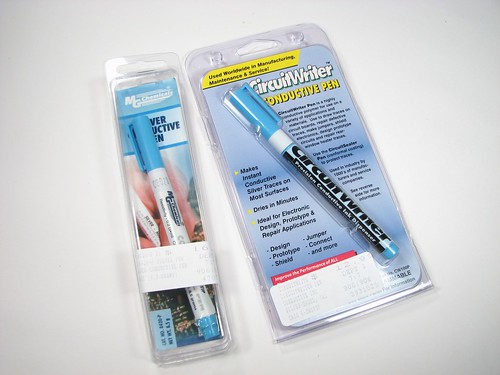
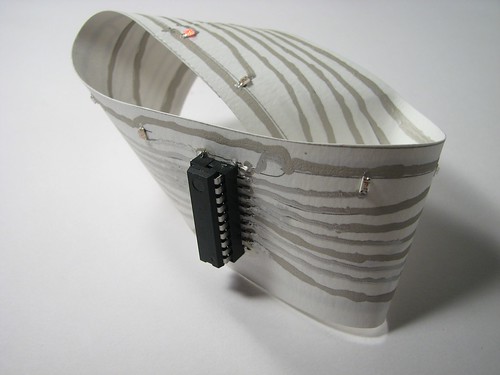
Draw your circuit on paper!


Come across this good tutorial about making your circuit with conductive pen!
Make your own circuit will be much easier:) just draw the wires on paper.


Please check out the full article here:
http://www.evilmadscientist.com/article.php/mobiuscircuit

Monday, February 2, 2009

LED flower vase supplementary note.


Some of the viewers requested for the source codes and also the circuit diagram, kaas is no longer working on his blog, so let me write you all a supplementary note.

Of course, I don't own a circuit diagram, but I can draw you all a block diagram:


Remember, it is only a draft block diagram, power and resistors are not shown in this diagram, please try to add your own:)

The complete working source codes: Download Now (Only tested compilation on Mac OS X with avr-gcc).

Send me your led vase's photo if you successfully made one:) Have fun!